Summary:This article analyzes the impact of a new federal infrastructure bill on state infrastructure projects. It highlights that the bill provides significant federal funding for states to improve roads, bridges, public transportation, and other infrastructure. This article discusses how this influx of federal funds could accelerate state infrastructure projects and create jobs. It emphasizes the importance of states effectively managing these funds to maximize their impact. The new federal bill has the potential to transform state infrastructure and boost economic growth.
The Impact of the New Federal Bill on State Infrastructure Projects
The H.R.1 – One Big Beautiful Bill Act (OBBBA), signed into law by President Trump on July 4, 2025, has garnered the attention of almost every sector of the American economy, including infrastructure.
This bill modifies specific provisions of the Inflation Reduction Act of 2022 (IRA) and is significant for its spending reductions and tax cuts, which have implications for individuals and families, businesses, and state infrastructure projects.
What Does the OBBBA Mean for State Infrastructure Projects?
With the OBBBA now in effect, several sectors will undergo significant changes. Let’s examine the impact of the new federal bill on state infrastructure projects in the following sectors.
Cutback to unobligated financing: One of the provisions of the new bill is the withdrawal of approximately $2.4 billion in unobligated funding from the Neighborhood Access and Equity (NAE) Program. This clawback implies that cities with grant agreements will lose funding if they weren’t obligated before July 4, 2025. Furthermore, grantees awaiting NAE award funds will no longer receive them from the DOT. Similarly, the bill rescinds unobligated funding from several sustainability grants previously funded by the EPA.
Elimination of the bicycle commuter tax benefit: The bill eliminates the suspended bicycle commuting reimbursement, meaning it won’t be reinstated in 2026.
Rollback on tax credits for electric vehicles: Electric vehicle (EV) initiatives created to incentivize the purchase and use of EVs will no longer benefit from specific tax benefits under the IRA. The OBBBA eliminates the $7,500 tax credits for new EVs and the $4,000 tax credits for used EVs. Additionally, the bill eliminates tax credits for EV charging infrastructure, effective as of June 30, 2026.
Funding allocation for air traffic control systems: The bill allocates $12.5 billion to modernize air traffic control systems.
Energy
The energy sector, particularly renewable energy, is undergoing notable changes due to IRA modifications, as established by the OBBBA. Generally, these modifications exclude energy projects for which construction commenced by the end of 2024. While the bill reduces significant tax incentives that have sustained clean energy projects since the enactment of the IRA, it strengthens support for the fossil fuel industry.
Some noteworthy changes the OBBBA makes to the energy sector include:
More stringent FEOC requirements: The new federal bill introduces stricter rules guiding the eligibility of foreign entities of concern (FEOC) for clean energy tax credits. The new rules provide that projects owned or assisted by specific prohibited foreign entities, including Russia, China, Iran and North Korea, don’t qualify for tax credits — specifically credits under sections 45X, 45Y and 48E of the IRA. While these restrictions aim to reduce dependence on foreign markets, they add complexity to determining eligibility.
Accelerated deadlines for phasing out tax credits: Several energy projects are now under tighter deadlines to qualify for tax credits. For instance, the bill requires wind and solar projects to commence by July 4, 2026, to be eligible for investment and production tax credit eligibility under the IRA. Furthermore, it terminates tax credits for projects in service after December 31, 2027.
Limits on tax credit transferability: The OBBBA retains key tax credit transferability provisions contained in section 6418 of the IRA, provided they remain active and within the accelerated deadlines. However, it imposes new prohibitions on the transfer of energy tax credits to Specified Foreign Entities and Foreign-Influenced entities.
Housing
The new bill has provisions that impact state infrastructure projects in the housing sector. These provisions, which affect deductions and credits, are as follows:
SALT deduction: The bill provides for an increase in the State and Local Taxes Deduction (SALT) to $40,000 from the initial $10,000 for household incomes under $500,000. This cap will increase by 1% every year until 2029 and revert to $10,000 in 2030.
Expansion of LIHTC: Specific provisions in the OBBBA permanently expand low-income housing tax credits (LIHTC) and new market tax credit incentives for developers who build and maintain affordable housing. More specifically, the bill authorizes a credit allocation increase of 12%, while bringing the bond financing limit down to 25% from 50%. Experts predict that the expansion of the LIHTC will lead to increased production of affordable housing, with a projected 1 million low-cost rental homes by 2035.
Extension of Opportunity Zone tax incentives: The bill’s provisions make the federal Opportunity Zone program, created in the Tax Cuts and Jobs Act of 2017 (TCJA), permanent to promote the economic development of rural areas. Additionally, the bill creates stricter rules for determining eligibility for this program. For instance, the low-income community benchmark has been reduced to 70% from 80%, while the exemption for contiguous tracts has been repealed.
What Does the Big Beautiful Bill Mean for the Construction Sector?
The OBBBA has several upsides for the construction sector, including workforce employment and development and tax certainty. However, it also has potential downsides.
Opportunities for Construction
The following are some areas of opportunity for the construction industry as a result of the new bill.
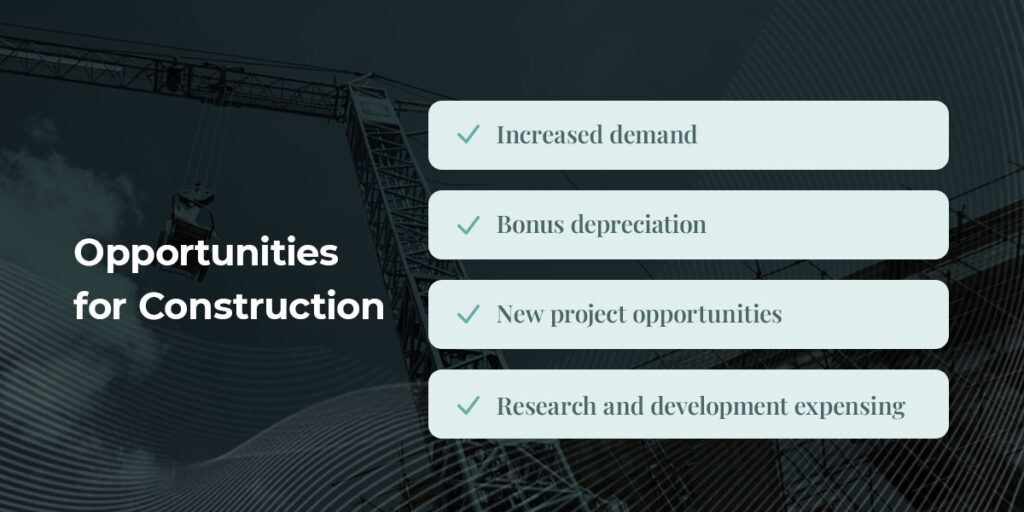
Increased demand: The impact of the new federal bill on state infrastructure projects could potentially lead to increased demand in the construction sector. For instance, the bill prioritizes upgrading air traffic control systems, an initiative that can drive higher demand for construction services.
Bonus depreciation: The previous provisions of the TCJA lowered bonus depreciation for property placed in service in 2025 to 40%, with complete elimination by 2027. In contrast, the OBBBA reinstates a 100% bonus depreciation allowance for qualified property placed in service after January 19, 2025. This change allows construction companies to deduct the full cost of assets such as machinery and free up cash flow for operations or new projects.
New project opportunities: The permanence of the Opportunity Zone Program under the bill creates long-term opportunities for the development of eligible rural areas.
Research and development expensing: The TCJA requires domestic research and development expenses incurred in tax years beginning after December 31, 2024, to be capitalized and amortized over five years. However, under the new bill, construction companies investing in new technologies and engineering designs may qualify for R&D expense deductions.
Challenges for Construction
Some potential drawbacks of the bill for construction companies include:
Increased cost: Due to the rollback of clean energy tax credits, construction companies may face increasing costs if they don’t meet the accelerated deadlines for energy-efficient projects.
Planning challenges: The new accelerated deadlines for phasing out tax credits may pose a planning challenge for project developers and clean energy investors. Developers may be forced to reassess their plans to secure credits before the deadline.
Excess business loss limitation: Construction companies with fluctuating incomes may be affected by the provisions of the OBBBA, which makes the excess business losses rule permanent.
Get Help to Navigate the New Tax Landscape Under the OBBBA
The new federal bill on state infrastructure projects has several implications for construction companies concerning planning, expenditure and tax strategy. It’s essential to stay updated with the new regulations and the impact they have on your business.
If you need OBBBA construction tax guidance or help developing new tax strategies, Polston Tax can assist. Our services, ranging from tax planning, preparation and resolution to accounting and bookkeeping, can help businesses stay ahead of the curve. Schedule a free consultation today.