


Logging on from your kitchen table instead of the office cubicle was initially a temporary measure due to the COVID-19 pandemic. Today, approximately 26% of Americans are working fully remote, and 52% are working on a hybrid basis.
For individuals working for companies across state lines, navigating tax rules can be challenging. The convenience of working from home may lead to an additional tax bill from another state tax entity.
This guide examines remote work and its implications for multistate tax compliance. Explore these essential guidelines to avoid double taxation and penalties.
Governance around remote work taxation has changed, with stricter enforcement replacing the flexibility afforded to remote workers. Alongside changing work setups, state taxing entities have taken measures to ensure you can file income tax returns for additional states.
With more Americans switching to remote work, the temporary or emergency status of remote work is no longer the case. Administrative rules and tax code changes across some state taxing entities are in place to monitor cross-state-line remote workers.
Code and rule changes aim to implement enforcement on the collection of nonresident taxes. These changes lead to greater compliance among workers and employers.
Especially for business owners and contractors, the opportunity to earn wages in multiple states may require filing returns in each state. Multiple filings can happen even if your business has not moved to a new permanent location.
Some states may have minimal requirements to request a tax return. To determine multistate earnings, tax agencies use various resources, such as payroll data and 1099 forms. This data collection makes it challenging to stay compliant, especially if you earn income from several states at once.
Some state taxing entities are implementing enforcement measures to increase revenue from remote workers. An auditing focus includes temporary jobs or contracts in a different state that trigger an audit.
Whether you frequently work as a contractor across state lines or complete one single contract, all circumstances can factor into filing nonresident returns. A state may issue notices and potential penalties if you do not file a return.
The convenience of the employer rule dictates that income earned is taxable in the employer’s state. The rule applies to workers who work remotely for personal reasons, rather than remote working as an employer requirement.
Therefore, you may owe taxes in your employer’s state, even if you work at home from another state. Depending on your position and how many days you work in the state, the convenience of the employer rule may be relevant if your employer is located in:
Filing a state return is typically not necessary if you live in a state without income tax, but you may owe state income taxes if your employer is in a state where the convenience of the employer rule applies.
A reciprocity state is one in which individuals pay income tax only in their home state. If a reciprocity agreement is in place between two states, you may only need to file a return in your home state if your employer has filed exemption paperwork. However, many states with the convenience of the employer rule do not have reciprocity agreements, or those agreements do not override the convenience rule.
To qualify as a remote worker and possibly avoid the convenience of the employer rule, your remote work must be for your employer’s benefit or business necessity rather than an arrangement for your personal preference.
In some cases, your home state may tax the income you earn in another state. Additionally, the state taxing entity where your company is may also tax your income. If your work state tax applies the convenience of the employer rule, you’re at risk of double taxation.
However, many state taxing entities provide a credit for the taxes you pay to your work state if you live in a different state. This credit helps prevent double taxation, though some states may not offer a credit or may provide only a limited credit.
If you’re an independent contractor, navigating working remotely in another state and taxes is vastly different than if you’re a W-2 employee. Even if you work individually as a self-employed contractor, the Internal Revenue Service (IRS) or state taxing entity labels your operation as a business:
Positives to remote working and navigating tax regulations include deductible expenses. The rules governing these expenses vary depending on whether you’re an individual contractor or a W-2 employee:
Federal law prohibits employees from deducting work expenses, such as home office expenses, on tax returns. Employers may reimburse for expenses through an accountable plan, which is not taxable income. However, it’s common to cover your own remote work costs.
Home office deductions for independent contractors are possible if you use a particular part of your home just for work purposes. Qualifying areas of your home can include a separate room or a dedicated workspace. To determine the deduction total, there are two methods:
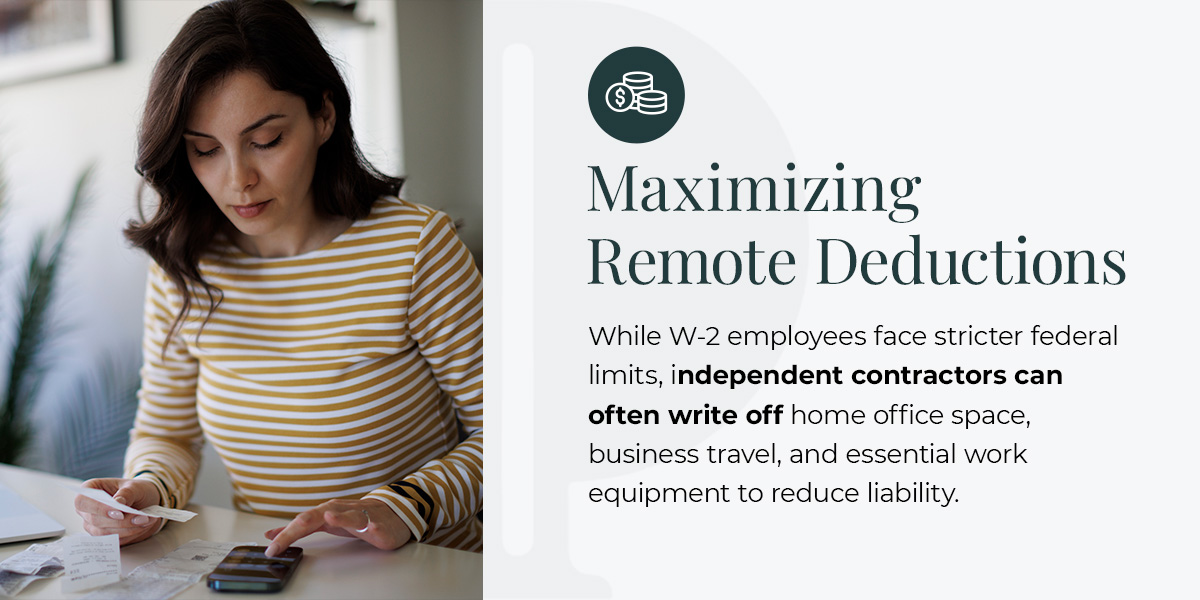
Other expenses for 1099 contractors may include:
Some states are making considerable efforts to target multistate income to address missed revenue opportunities. By following the points below, you may avoid a multistate tax audit:
Are you seeking guidance on managing multistate payroll issues? Our team at Polston Tax has the knowledge and experience to settle these issues effectively. Whether you need help with delinquent state taxes or dealing with state taxing entities, Polston Tax has got you covered.
Our professionals help individuals across all 50 states. Contact us today to schedule your free consultation and resolve your tax problems.