


Summary: This article discusses the Qualified Business Income (QBI) deduction, a tax break for owners of pass-through businesses. It highlights that the QBI deduction allows eligible taxpayers to deduct up to 20% of their qualified business income. This article explains the eligibility requirements and limitations, including income thresholds. It emphasizes that the QBI deduction is a significant tax benefit for many small business owners and self-employed individuals. Taxpayers should understand the rules and consult with a tax professional to determine their eligibility and maximize their QBI deduction.
Congress has made the 20% qualified business income (QBI) deduction permanent. That means small business owners have no uncertainty, so you can plan confidently starting in the 2026 tax year and beyond.
At the state level, QBI deductions vary. While some states conform with the federal QBI deduction, others opt to decouple — this means that taxpayers must add QBI back into their state income. A few states may take a mixed conformity approach, meaning they adopt their own unique approach.
Small business owners need to pay close attention to their state’s adoption of federal QBI deductions. Taking early, proactive steps now protects your bottom line tomorrow.
The QBI deduction was originally part of the 2017 Tax Cuts and Jobs Act (TCJA). It allows eligible pass-through business tax deductions up to 20% of the business income through 2025. Congress is removing the sunset, making the QBI deduction a permanent tool for small business tax deductions. Now, there’s also more room to claim it.
Previously, phase-in thresholds would narrow at higher income levels. Now, the phase-in ranges will rise from $100,000 to $150,000 for joint filers and from $50,000 to $75,000 for other filing statuses. Plus, if your total QBI from active businesses hits at least $1,000, you get a minimum deduction of $400, starting in 2026.
The permanent federal QBI deduction doesn’t guarantee a state-level match. Each state decides whether to conform to federal tax law, and that choice affects whether you can claim a similar deduction on your state tax return.
Some states, called rolling conformity states, automatically adopt changes to the Internal Revenue Code (IRC) — however, static conformity states require legislation to adopt federal tax changes.
If your state conforms, you will see the QBI deduction apply at the state level. States that selectively adopt federal rules may decouple from the state QBI deduction, state and local tax (SALT) cap changes or pass-through entity tax (PTET) adjustments at the state level. Several states, including New York and California, ignore the QBI deduction entirely, meaning you get federal savings but no state-level benefit.
See where your state stands by:
While the permanence of the QBI deduction delivers certainty, the real advantage comes from how you plan around it. Long-term strategy determines how much you keep, not just claiming the deduction.
Making the most of the QBI deduction means evaluating your entity structure, income timing, investments and aggregation rules to maximize savings.
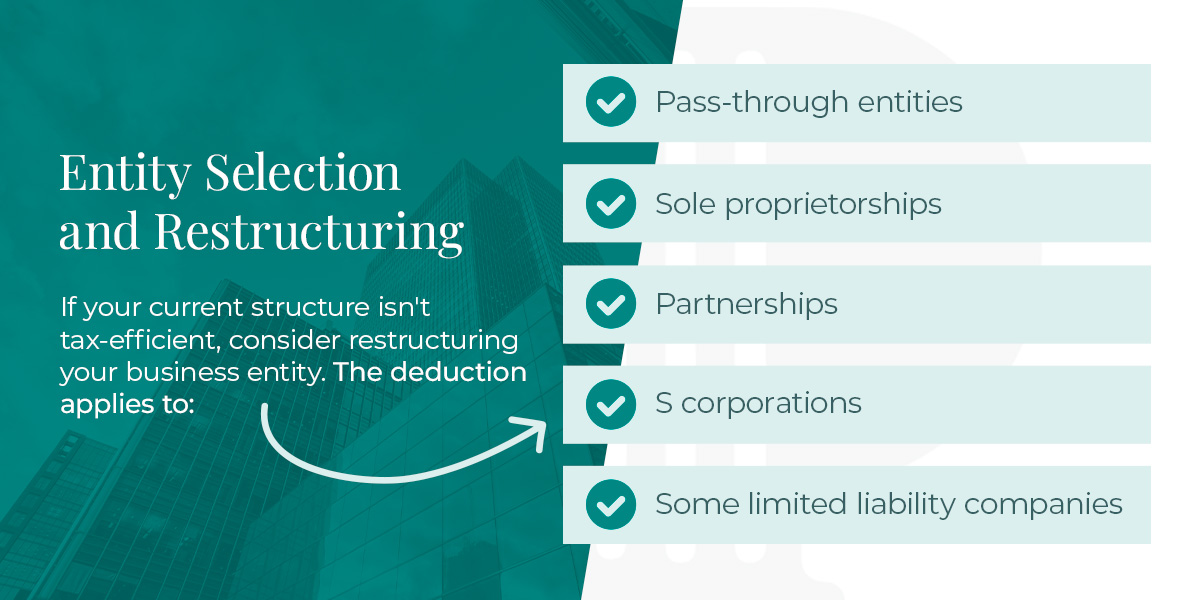
The deduction applies to pass-through entities, sole proprietorships, partnerships, S corporations and some limited liability companies (LLCs). C corporations don’t qualify. If your current structure isn’t tax-efficient, consider restructuring your business entity. For example, you can consider changing from a C corporation to an S corporation, which may let you claim the QBI deduction while optimizing self-employment tax.
Controlling income and expenses matters because deduction eligibility depends on taxable income thresholds. Boost deductible expenses in high-income years, defer income into lower-income years or adjust compensation strategies to preserve QBI eligibility. Investments in depreciable property or wages can also strengthen the deduction under the wage-and-capital limitation rules.
If you have more than one business, IRS aggregation rules may help. Combine businesses with common ownership to better meet wage or property requirements and secure the deduction. For example, a real estate holding LLC and an operating company under the same ownership may aggregate to maximize deduction potential.
Strong planning in these areas lets you use the deduction as a growth tool. For some owners, another factor plays a role — whether the business is considered a specified service trade or business.
Law, accounting, healthcare, financial services and consulting face stricter QBI limits — these face special considerations for specified service businesses (SSTBs). Once income exceeds their phase-out thresholds, the deduction phases out quickly until it disappears. That means a law firm partner earning $600,000 can lose most federal QBI benefits, while a similarly situated construction firm owner may keep the full 20% deduction.
Careful planning can help preserve SSTB eligibility. Consider restructuring compensation, separating qualifying activities or adjusting ownership.
With the rules set and the deduction here to stay, it’s time to ensure you’re capturing the full value, starting with clear, immediate steps:
At Polston Tax, we’ve assisted various businesses with tax planning and problem-solving since 2001. We offer bookkeeping and accounting services to streamline your taxes, helping you make the most of the QBI deduction. Partnering with us gives you access to skilled accountants and attorneys who help with:
The opportunity is clear with the permanence of the QBI deduction. With careful entity planning, income management and state-level strategy, this deduction can become a lasting tool for lowering taxes and reinvesting in business growth. However, without proactive planning, you may lose thousands in potential annual savings.
At Polston Tax, we understand how federal and state tax rules intersect. We aim to help small business owners protect profits, minimize liabilities and make confident long-term decisions. With the now-permanent QBI deduction, our accountants and tax professionals are ready to help you plan and secure a firmer financial footing in the next tax season.
Contact us today for a free consultation.