


Summary: This article discusses tax planning strategies for real estate investors. It highlights various tax benefits available to real estate investors, such as depreciation, deductions for operating expenses, and the ability to defer capital gains through strategies like 1031 exchanges. This article emphasizes the importance of keeping accurate records of income and expenses. It advises real estate investors to consult with a tax professional to develop a comprehensive tax plan that minimizes their tax liabilities.
If you’re an investor, analyzing your financial situation and understanding real estate tax laws can be crucial to maximizing tax efficiency. Staying knowledgeable allows you to create tax strategies that legally take advantage of tax deductions, exemptions and credits. Prepare for your 2026 taxes with this comprehensive tax planning guide.
With ever-changing tax laws, it’s vital to stay ahead of any regulatory shifts. Here are a few key areas to consider for 2026 tax planning.
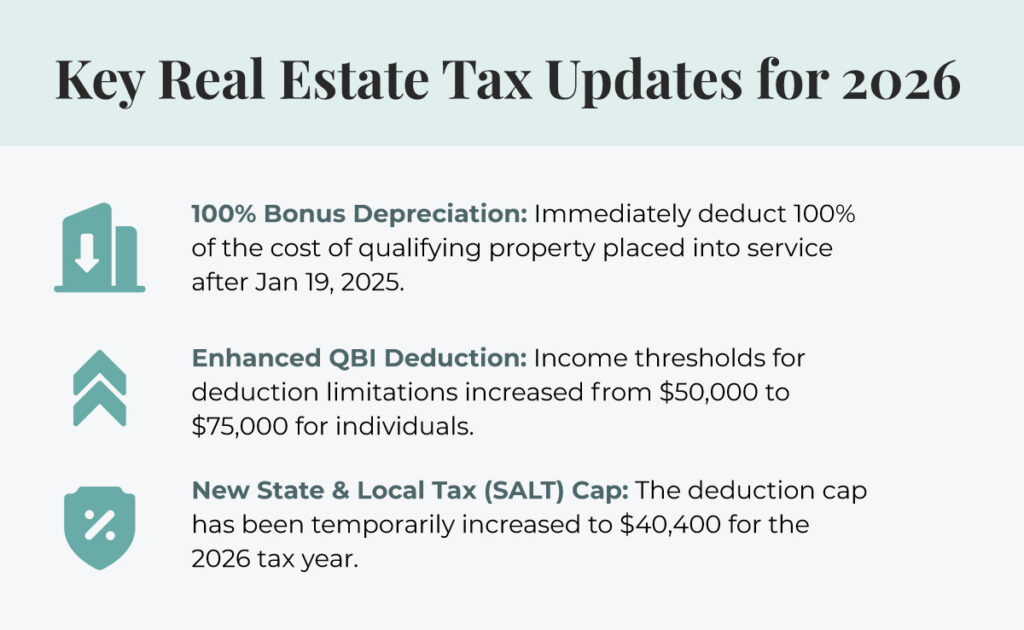
The “One Big Beautiful Bill Act” (OBBBA) became a law on July 4, 2025, and restored 100% bonus depreciation permanently. This bonus depreciation covers certain qualifying property placed into service after January 19, 2025.
The bonus depreciation lets you immediately deduct 100% of the cost of eligible property in the year it’s placed into service, rather than depreciating it slowly over many years. This restoration provides stability for real estate investors. If your property qualifies, the new depreciation law could significantly reduce your taxable income.
The OBBBA also extended and enhanced deductions for qualified business income. These changes have increased the income thresholds for deduction limitations from $50,000 to $75,000 for individuals. Qualifying small businesses can get a minimum deduction of $400.
As a real estate investor, these changes mean that you can earn more income before limitations kick in. This qualified business income includes self-employment taxes, self-employed health insurance and contributions to qualified retirement plans. If you have any of these income sources, make sure to take advantage of the new tax laws.
Finally, the OBBBA put a new cap on state and local tax deductions. The original $10,000 cap has been temporarily increased to $40,000 for the tax year 2025, with slight increases each year after. For 2026, the amount is $40,400.
This tax cap allows real estate investors and other high-income earners to deduct up to $40,400 of their state and local taxes for the 2026 tax year. This higher cap will remain in effect through 2029, so it’s best to talk to a tax professional about how this could impact your strategy for the coming year.
Tax planning is critical for helping real estate investors comply with tax laws and regulations. It may also help you avoid legal issues, penalties and fines. Some reasons why real estate tax planning is important include:
It’s best to start your real estate tax planning early in the year. At this time, you’ll want to:
In the middle of the year, check your progress and adjust accordingly. Adjustments might include reviewing unexpected income, changes in employment that affect your tax situation, new charitable contributions, and gains or losses on investments.
Then, in the last quarter, you can fine-tune your tax strategy to account for all income and expenses. Finalize your tax payments and benefits and maximize tax-advantaged accounts. These steps will help you align your tax strategy with broader financial goals.
Here are four top real estate tax strategies investors can use.
YYou may be able to leverage deductions as a real estate investor. Tax deductions are allowed for any expenses related to your rental property, including:
These deductions reduce your taxable income. Other deductions you may qualify for include mortgage interest, credit card interest and interest on loans or lines of credit taken out for your business. You can also take advantage of the latest changes in deductions for 2026, including depreciation, QBI and state and local tax caps. Real estate accounting software may help you maximize and keep track of your end-of-year deductions.
There are two types of capital gains tax:

You may be able to avoid capital gains tax on real estate by making the property your primary residence. You may then use the Section 121 exclusion to sell your primary residence and not pay capital gains of up to $250,000 as an individual. You can only claim the property as your primary residence after living there for two years out of the past five years.
Otherwise, you might sell your property and defer capital gains by investing in a Qualified Opportunity Fund (QOF). A QOF is designed to invest in Opportunity Zones, which could be anywhere within an established rural or financially distressed area.

A 1031 exchange allows you to exchange one real estate investment property for another like-kind investment and defer capital gains taxes. The capital gains from the relinquished property roll over to the acquired property, helping you avoid taxes until you cash out.
If you want to free up some cash or fund a new investment, borrowing against your equity might be another valuable solution. You can use a cash-out refinance to receive funds and a new mortgage on the property. This option can be better than selling when you don’t want to pay capital gains tax because mortgage payments with interest may be more affordable than capital gains taxes.
While long-term capital gains tax may go up to 20%, the average 30-year fixed-rate mortgage on residential real estate was 6.15% at the end of 2025. Mortgage rates will likely remain stable in 2026, with minimal movement up or down.
This real estate tax strategy allows you to deduct the loss on your taxes when the investment property does not appreciate in value. The depreciation deduction helps lower your total taxable income. However, if you sell the property and make a profit on it, you’ll need to report it to the IRS and state taxing entity as depreciation recapture. You may need to pay extra tax on this gain to cover the depreciation you deducted.
Investors must comply with real estate tax laws to avoid hefty penalties and fines. Some of the key compliance requirements include:
With various tax considerations, it’s helpful to take a comprehensive approach that helps you account for every aspect of tax compliance. Work with tax professionals to help you understand what taxes you owe and when you should pay them. A collaborative team of accountants, attorneys and financial advisors ensures all aspects of your particular situation are considered.
Are you looking to boost your real estate tax strategies? At Polston Tax, we have skilled and knowledgeable tax preparation teams and accountants who can help customize tax strategies to your unique situation and the latest tax regulations. We provide a collaborative team consisting of a tax preparer, tax attorney, accountant and case manager.
Our tax preparer will ensure you file the necessary deductions based on the information you provide and create strategies to help you lower yearly taxes. Meanwhile, our accountants can handle your monthly and quarterly reports to ensure you stay compliant. To enhance your real estate tax planning, contact our tax professionals today.