
Summary: This article details the necessity and process of making estimated tax payments for individuals and businesses with income not subject to withholding. It explains that estimated taxes cover income tax, self-employment tax, and alternative minimum tax, primarily targeting self-employed individuals, independent contractors, and those with significant rental, dividend, or interest income. A key insight is the requirement to pay estimated taxes if one expects to owe at least $1,000 in tax and withholding. The article outlines the quarterly payment due dates and methods for calculating payments using Form 1040-ES, emphasizing adjustments for fluctuating income. It also warns against underpayment penalties and advises proactive financial planning and record-keeping to ensure compliance and avoid unexpected tax burdens.
When you work a traditional W-2 job, your employer handles tax withholding automatically. A portion of every paycheck goes directly to the IRS or state taxing entity to cover your tax obligations throughout the year. But when you become self-employed, launch a side business or start earning income as a freelancer or contractor, that automatic system disappears.
Suddenly, you have to manage your own tax payments, which many new business owners don’t realize until they’re facing a large tax bill or IRS penalties. If you’re earning income without withholding, understanding estimated tax payments isn’t optional, and you may be required to make them depending on your expected tax bill. Getting it right helps you avoid costly penalties and interest.
Before you can determine if you need to make these payments, it’s important to understand what they are and why they exist.
The United States operates on a “pay-as-you-go” tax system. This means you’re required by law to pay taxes as you earn income throughout the year, not just on Tax Day. While employees have their taxes withheld by their employers on every paycheck, self-employed individuals and business owners must make estimated tax payments to fulfill this obligation.
Besides income tax, these quarterly installments also cover self-employment tax and alternative minimum tax. Self-employment tax is particularly important to understand, as it covers Social Security and Medicare contributions. When you work for an employer, they pay half of these taxes, but as a self-employed worker, you’re responsible for both the employer and employee portions.
Now that you understand what estimated tax payments are, the next question is whether you have to pay estimated tax payments.
If you expect to owe $1,000 or more after you subtract any withholding and refundable credits, you generally must pay estimated taxes. This requirement can apply to various types of income, such as:
Most people who need to make estimated tax payments fall into a few common categories:
If you’re managing multiple income sources or have recently become self-employed, small business tax and accounting services can help you navigate your obligations.
Not everyone has to make estimated payments. You’re exempt if you meet the exemption requirements, which include:
You can also avoid estimated payments by increasing withholding from a W-2 job to cover both income sources.
Once you’ve determined that you need to make estimated payments, the next step is calculating how much to pay. The IRS offers two main methods to help you avoid underpayment penalties.
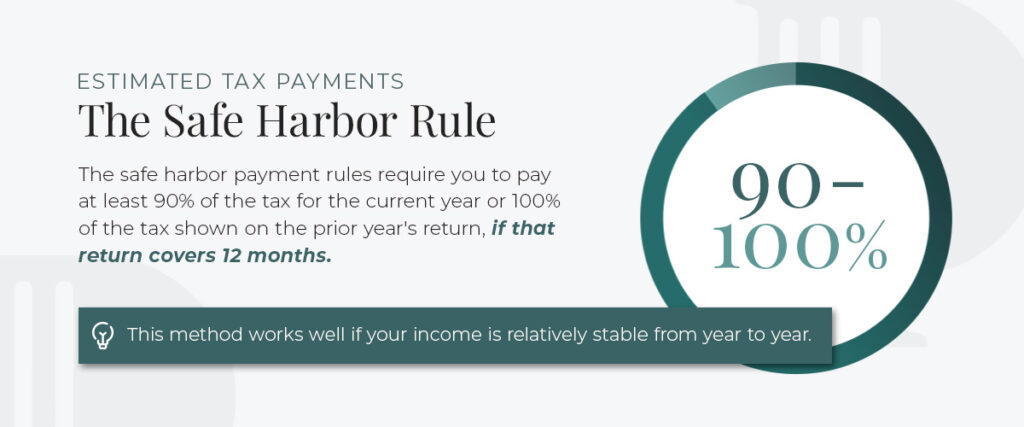
The safe harbor payment rules require you to pay at least 90% of the tax for the current year or 100% of the tax shown on the prior year’s return, if that return covers 12 months. If you have an adjusted gross income of more than $150,000, or $75,000 if you’re married and filing separately, you’ll need to pay 110% of your prior year’s tax. This method works well if your income is relatively stable from year to year.
If your income varies throughout the year, the annualized income method lets you vary the amounts of your payments based on when you actually earn income. However, this method is considerably more complex and requires detailed record-keeping, which is why professional tax preparation services are valuable for accurate calculations and compliance.
Understanding the timing and mechanics of making payments helps you stay compliant and avoid penalties, but you still have to actually make the payments.
To calculate and pay your estimated taxes, you’ll use Form 1040-ES, which you can download and fill out.
Estimated tax payments are made quarterly. The four standard due dates for 2026 are:
Missing these deadlines may cause penalties and interest to start accruing from the due date, so mark them on your calendar. In some cases, you may be able to skip the January payment if you file your return and pay the full amount due by early March.
The IRS offers several convenient payment methods:
Understanding the financial risks of noncompliance reinforces why paying estimated taxes matters.
If you miss a quarterly estimated tax payment, the IRS or state taxing entity may charge penalties for both failing to pay enough tax throughout the year and for paying late. The underpayment penalty is calculated based on the amount you underpaid, the time period and a variable interest rate. Any interest is charged on top of penalties, which means the amount you owe can grow quickly if left unaddressed.
The best way to avoid penalties is to make your payments on time. If you do face penalties, a professional penalty abatement service can help.
When it comes to managing your tax obligations, working with experienced professionals can make all the difference.
At Polston Tax, we’ve helped business owners, self-employed individuals and contractors navigate complex tax obligations since 2001. When you work with us, you get the combined knowledge of tax attorneys, case managers, accountants and tax preparers working on your behalf. What’s more, we also work with the IRS and state taxing entities every day, so we know what strategies work and how to negotiate effectively.
Managing estimated taxes can feel overwhelming, especially when you’re already focused on running your business. Calculating the right amount, meeting quarterly deadlines and avoiding IRS penalties requires careful attention, and mistakes can be expensive.
At Polston Tax, we take the stress out of tax compliance, allowing you to stay on track with your tax payments so you can focus on your core business goals.
To find out if estimated tax payments apply to you, or for help paying your estimated taxes, schedule a free consultation today and learn how we can help you avoid penalties and stay compliant.