


When navigating a divorce or separation, having the IRS involved can make it even more challenging. You’ve come across two programs — innocent spouse relief and injured spouse relief — and the names sound nearly identical. Which one applies to your situation? Without guidance, it’s almost impossible to tell.
Both programs exist for married or formerly married individuals who filed joint returns, but they solve different problems. One addresses the tax liability that resulted from your spouse’s errors. The other recovers a refund that was seized to cover your spouse’s separate past-due obligations. Understanding the difference is the first step toward resolving your IRS issue and moving forward with confidence.
Innocent spouse relief removes your liability for taxes owed that resulted from your spouse’s mistakes on a joint return — unreported income, incorrect deductions or fraudulent claims you knew nothing about.
Injured spouse relief recovers your portion of a joint refund that was seized to cover your spouse’s individual overdue obligations, like unpaid child support or student loans.
These are two distinct problems requiring two distinct solutions. The program you need depends entirely on whether you’re facing an unexpected tax balance or a missing refund.
Innocent spouse relief exists to protect you from being held responsible for taxes owed because of errors your spouse made on a joint return. When you file jointly, the IRS holds both spouses legally responsible for the entire tax balance — a concept called joint and several liability. According to IRS Publication 971, this responsibility applies even if the errors were made solely by one spouse, and it continues even after divorce.
You can be held liable for unpaid taxes resulting from income you never saw or deductions you didn’t know your spouse claimed. Innocent spouse relief was designed to correct this injustice by allowing you to request relief from that liability under specific circumstances.
The IRS has clear IRS innocent spouse relief eligibility requirements, and meeting them is essential to your case. To qualify, you must have filed a joint return that didn’t report all the taxes owed because your spouse made errors — they didn’t report income, claimed deductions they shouldn’t have or took credits incorrectly. When you signed the return, you had no idea about these errors and had no reason to suspect them. Given your situation, it wouldn’t be fair for the IRS to make you pay for your spouse’s mistakes.
You must generally file Form 8857 within two years of the first IRS collection activity against you, though the deadline varies for equitable relief. The IRS review process can take six months or longer, but they cannot collect from you for that tax year while your request is pending. However, they can still pursue collection for other tax years while your request is under review.
When you file Form 8857, the IRS automatically evaluates all types of innocent spouse relief to determine which one fits your situation. You don’t need to choose — they’ll consider each one on your behalf.
Injured spouse relief solves a completely different problem. Your joint return isn’t necessarily wrong, and there’s no error to correct. Instead, your portion of a joint refund was intercepted by the IRS or Bureau of the Fiscal Service to cover your spouse’s separate past-due obligations — obligations you’re not responsible for.
When you file jointly and are due a refund, the IRS can apply that refund to cover either spouse’s past-due obligations before issuing the check. Those obligations can include:
To recover your portion of the refund, you file Form 8379. According to IRS instructions for Form 8379, you can file it with your original joint return if you know an offset is coming, or you can file it separately after the offset occurs. To qualify, you must have reported income or made tax payments — withholding or estimated payments — on the joint return.
Processing time varies. If you file Form 8379 with a paper joint return, expect approximately 14 weeks. If you file it separately after the joint return has already been processed, expect approximately eight weeks.
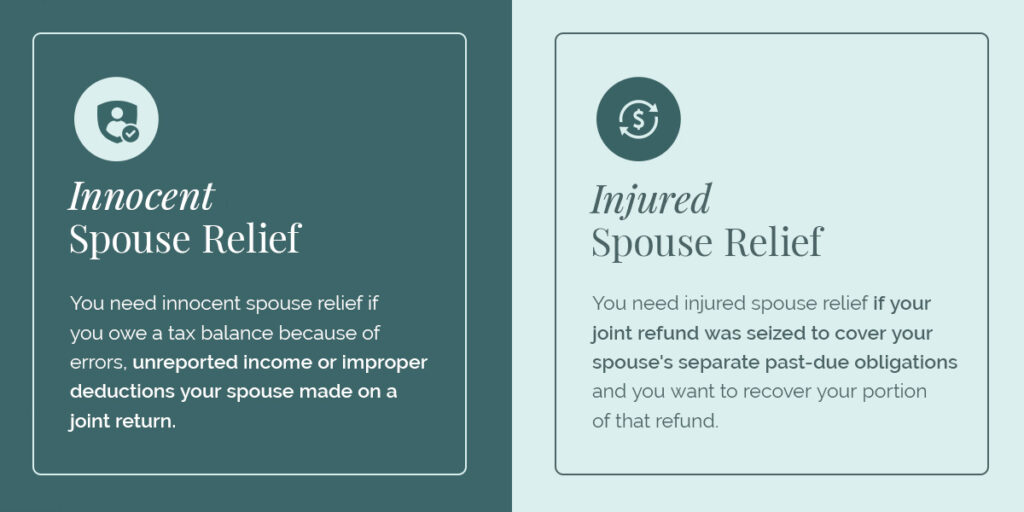
The IRS provides tax relief for spouses in two distinct scenarios, and understanding which applies to your situation is essential.
You need innocent spouse relief if you owe a tax balance because of errors, unreported income or improper deductions your spouse made on a joint return. You didn’t know about the errors when you signed, and you believe it’s unfair for the IRS to hold you responsible for taxes owed that resulted from your spouse’s actions.
You need injured spouse relief if your joint refund was seized to cover your spouse’s separate past-due obligations — child support, student loans, back taxes or other debts — and you want to recover your portion of that refund.
It’s uncommon, but possible, for a taxpayer to need both programs. These programs don’t overlap in their purpose. One addresses liability for unpaid taxes, and the other addresses refund recovery. If you’re unsure which program applies or if your situation is more complicated than these two scenarios, professional guidance can help ensure you pursue the right relief and file the correct forms. When navigating IRS issues during divorce, understanding your options early makes all the difference.
At Polston Tax, we’ve been resolving IRS and state tax issues since 2001, and innocent spouse relief is a core part of what we do. When you work with us, you get a full team behind your case — a tax attorney, case manager, accountant and tax preparer all working together to build the strongest possible case on your behalf. We work with the IRS every day, which means we know what to expect, what documentation matters and how to negotiate effectively.
We handle all communication with the IRS or state taxing entity on your behalf, so you’re never navigating this alone. Whether you’re facing liability for your spouse’s errors or trying to recover a seized refund, our innocent spouse relief services are designed to take the burden off your shoulders and get you the relief you deserve.
If you’re confused about which relief program applies to your situation or overwhelmed by the prospect of dealing with the IRS or state taxing entity on your own, Polston Tax is here to help. We take complete ownership of your case, handling all communication with the IRS or state taxing entity, evaluating which program fits your circumstances, filing the correct forms and negotiating the best possible outcome on your behalf.
You don’t have to navigate this alone. Start with a free consultation — no commitment required. We’ll help you get clarity on your situation and chart a path forward. Contact Polston Tax today or explore our tax relief services.