


A passport denial notice rarely arrives at a convenient time. Maybe a work trip is booked, a renewal is due, or a family visit abroad is on the calendar. For anyone who has received a CP508C notice or a Letter 6152, or who owes a significant tax balance and travels internationally for work, IRS passport revocation is a real disruption to income and mobility.
Since 2015, federal law has given the IRS authority to certify seriously delinquent taxpayers to the State Department under the FAST Act, which can result in a passport being denied or revoked. For many, a passport is more than just a travel document — it’s also a business tool and a lifeline for international access.
The IRS defines a seriously delinquent tax debt as unpaid federal taxes, which include interest and assessed penalties, that total more than a threshold set annually. The 2026 threshold is set at $66,000, although this is adjusted annually for inflation. The threshold can include Trust Fund Recovery Penalties, individual income taxes, business taxes that you’re personally liable for and other civil penalties.
Owing above that threshold alone isn’t enough to trigger certification. All three of the following conditions must be true to trigger certification:
Once all three conditions are met, the certification process automatically begins, and federal law requires the IRS to notify the State Department.
Understanding IRS passport revocation for tax debt starts with knowing the two agencies involved. First, the IRS certifies your account as seriously delinquent. The State Department is then the one that actually denies or revokes your passport, meaning the IRS itself never physically pulls your passport.
When the IRS completes State Department tax debt certification, it mails a Notice CP508C to your last known address while notifying the State Department. The IRS typically attempts collection multiple times before issuing a CP508C notice.
Once certification is complete, any new passport application results in a passport being denied for taxes owed. If you already hold a passport and submit a renewal, the State Department holds that application open for 90 days, so you’ll have more time to resolve your tax balance. After 90 days with no resolution, it’s denied and closed.
Note that the IRS does not send a copy of the CP508C notice to your power of attorney.
Certification and revocation aren’t the same. Certification blocks new passports and pauses renewals, but doesn’t strip a passport you already hold. A separate revocation referral is what actually puts an existing passport at risk.
Before making that referral, the IRS sends Letter 6152, a notice of intent to request revocation. This gives the taxpayer 30 days to contact the IRS and resolve the balance before the referral goes through.
Once submitted, the State Department can revoke the passport without further notice. That said, the IRS generally won’t recommend revocation if you’re making a good-faith effort to resolve your tax balance, which is why responding to Letter 6152 quickly matters.
Owing more than $66,000 doesn’t automatically put your passport at risk, as certain situations exclude a taxpayer from certification even when the threshold is met. However, these protections aren’t always automatic and may require action to claim.
You may be excluded from certification if you have:
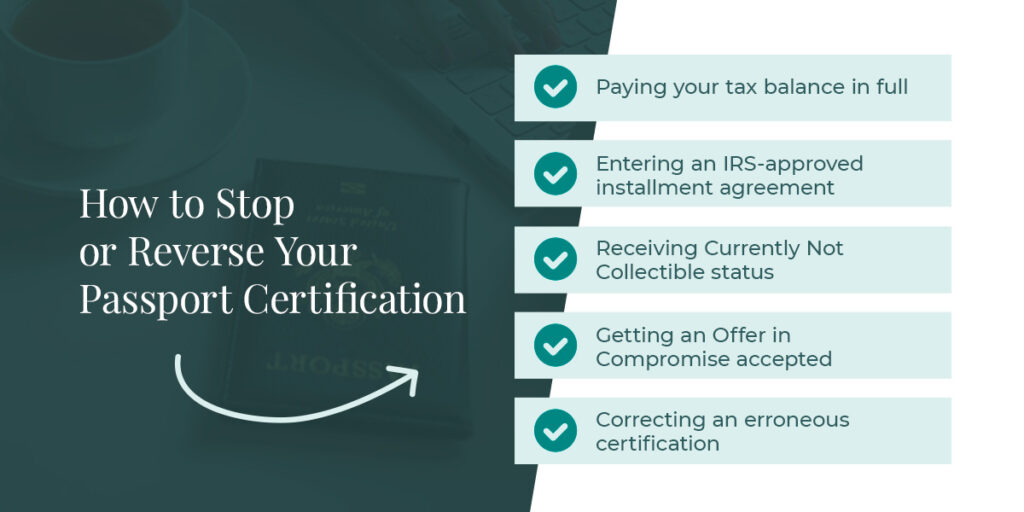
Certification isn’t permanent, but reversing it takes action on your part. Once your situation is resolved, the IRS is required to reverse certification within 30 days of resolution and inform the State Department.
Several paths can lead to reversal:
It’s worth noting that partial payments that bring your balance below $66,000 do not trigger automatic reversal.
At Polston Tax, we’ve spent more than two decades helping taxpayers navigate IRS and state tax situations, including passport certification cases like this one. Since 2001, our team has built a process around collaboration, with tax attorneys, case managers, accountants and tax preparers all working your case together from start to finish, rather than passing you between departments.
We also work directly with the IRS Practitioners Line, often meaning faster answers than contacting the IRS alone. Whether your situation calls for an installment agreement, Currently Not Collectible status or an Offer in Compromise, we’ve guided taxpayers through each path. A free consultation gives you a clear picture of your options with no commitment.
Questions about IRS passport revocation are common, but we’re always happy to provide the answers you need.
If you have urgent travel planned within 45 days, have an open or pending passport application, and are eligible for decertification, you can request expedited processing directly with the IRS. To be eligible for decertification, you must have paid your balance in full or entered into an agreement with the IRS, such as an Offer in Compromise.
The IRS generally completes the process in nine to 16 days. However, this doesn’t guarantee the State Department will issue your passport in time, since the State Department retains sole authority over that decision.
You must already have an open passport application or a pending renewal request to qualify. This is a narrow window, so apply as soon as travel plans are confirmed.
No, the IRS sends both a CP508C notice and a Letter 6152 before requesting revocation, so a warning process does exist. However, once the IRS submits a revocation referral to the State Department, the State Department can act without providing you further notice. That’s why waiting after receiving either notice is risky. Both come with hard deadlines, and once those deadlines pass, your options narrow considerably.
If your passport is certified or revoked while you’re already overseas, the State Department can issue a limited-validity passport that allows return travel to the United States only. This is not a full passport, and no further international travel is permitted until your tax balance is fully resolved.

You don’t have to wait for a revocation notice to take action, and you don’t have to face the IRS alone if one arrives. At Polston Tax, our team handles all communication with the IRS on your behalf, from the first phone call to the final resolution.
To find out how we can help protect your passport access, contact us today.