


Summary: This article provides a comprehensive guide to Missouri sales and use tax for businesses. It outlines the state’s 4.225% sales tax rate, which combines with local taxes for an average of 8.36%, and clarifies the application of use tax for out-of-state purchases. The guide details how businesses establish economic and physical nexus in Missouri, requiring remote sellers to collect tax if sales exceed $100,000 annually. It lists taxable goods and services, specific industry taxes like lodging and alcohol, and various exemptions. Important insights include the back-to-school sales tax holiday and critical steps for registration, filing, and avoiding penalties.
Understanding your tax obligations in Missouri is important, as failure to meet these obligations can lead to penalties and interest charges. One aspect of Missouri tax that many businesses and individuals find complex is sales tax. From recognizing which transactions are subject to sales tax to knowing how much you need to pay, it can be a challenging tax area to navigate on your own.
With the help of a comprehensive guide, you can learn everything you need to know about how to pay Missouri sales tax and meet your obligations.
Understanding Missouri’s origin-based sales tax system is crucial, as businesses must collect sales tax at the rate in effect at their place of business. The Missouri sales tax rate is 4.225%. However, some districts, counties and cities in Missouri may also impose additional local sales tax. This means the amount of sales tax that businesses collect varies depending on their location.
It’s important to note that up to 7.75% of additional local taxes can be added to sales tax. The combined average sales tax rate for Missouri in 2026 is 8.44%. This sales tax applies to retail goods and certain services unless they’re exempt by law, which we cover in detail below. Some of these goods include physical products such as home appliances, clothing and furniture. Businesses that make sales must collect sales tax from customers and remit it to the Missouri Department of Revenue (DOR) for distribution.
As a business owner, you’re responsible for collecting tax from purchasers on behalf of Missouri and paying it to the DOR. Failing to pass along this tax means you could be in violation of your tax liability, potentially resulting in penalties and interest charges.
Use tax is essentially the same as sales tax, except it applies to goods distributed, consumed, used or stored in a state or location where a consumer does not pay sales tax. This means the Missouri use tax rate is 4.225% — the same as the sales tax rate.
As with sales tax, use tax is also subject to additional local tax. Unless consumers have already paid tax to the seller, or the property is exempt from taxation, they must pay use tax on their purchase of goods. These goods include any tangible personal property that is consumed, stored or used in Missouri.
While sales tax requires a sale to occur in the state, consumers must pay use tax on tangible personal property even if the sale didn’t happen in Missouri. For instance, if a consumer purchases something from an out-of-state seller and does not pay Missouri sales tax to the seller, they will be responsible for the individual consumer’s use tax.
The same tax liability applies if a consumer purchases from someone not officially engaged in business. However, use tax does not apply if a consumer purchases from a Missouri seller subject to the state sales tax.
Business owners are responsible for collecting sales tax on retail sales from customers. However, use tax is more complex. In Missouri, if an out-of-state retailer does not collect use tax from a consumer residing in Missouri, the consumer is responsible for remitting the use tax to the Missouri DOR.
However, this only applies if the out-of-state retailer does not have a nexus with Missouri.
Nexus is the minimum legal connection between a business and a taxing jurisdiction that grants the government authority to require the business to collect and remit taxes. Any seller that sells tangible personal property to consumers in Missouri and meets the minimums for nexus must collect and remit sales tax.
Additionally, a seller who is not engaged in business is not responsible for collecting Missouri use tax. In this case, the purchaser would be required to remit use tax to the state by filing a use tax return if their total purchases exceed $2,000 per year.
In previous years, businesses could only maintain sales tax nexus if they had a physical presence in the state where they made their sales. If a company sold to consumers in another state but didn’t have a physical presence there, they couldn’t collect sales tax. However, a 2018 Supreme Court ruling changed the rules about physical presence regarding sales tax.
Since this decision, states can now tax businesses and sellers through their virtual, as opposed to direct, connection to the state. This is known as an economic nexus, which enables out-of-state companies and sellers to collect sales tax on behalf of the state of Missouri.
Remote and online retailers and marketplace facilitators that surpass $100,000 in sales within a calendar year to Missouri consumers are considered to have economic nexus and must collect sales tax. This means businesses selling their goods online can collect and remit sales and use tax — if applicable — regardless of their location.
Because of this law, there is no minimum number of transactions required for businesses to be allowed to collect Missouri sales tax. No matter how many sales your e-commerce retail shop makes, if you earn more than $100,000 from Missouri consumers in one year, you qualify for economic nexus.
If you establish economic nexus in Missouri, you must register for a Missouri sales tax permit before you can start collecting the tax from your customers. You can review your gross receipts from taxable sales from the previous year to determine if your business has met the $100,000 sale threshold.
A business is considered to have physical nexus in Missouri if it has:
Even if you don’t have any of the above qualifications, your business may still maintain economic nexus in Missouri.
Remote businesses and marketplace sellers that sell goods in Missouri must collect and remit local use tax on their sales if their gross earnings exceed the $100,000 threshold for the year.
Remote sellers must register with the Missouri DOR and file a vendor’s use tax return, but marketplace sellers that only sell through a marketplace facilitator — meaning they do not make sales independently — are not required to do so.
In Missouri, a wide range of items or property can be subject to sales tax. Common items and property that are generally considered subject to sales tax include:
A wide range of services can also be subject to Missouri sales tax. These services, such as installing, servicing or maintaining tangible personal property, can affect homeowners. They can also be commercial services, such as labor used to fabricate products. Telegraph services, plus local and long-distance telecommunication services, are also subject to Missouri sales tax.
Like with sales tax, use tax can apply to many types of purchases in Missouri, such as:
Sales and use tax are required for most purchases in Missouri. Because different districts, counties and cities can place an additional sales or use tax rate depending on your location, it’s important to know how this impacts various industries. For instance, if your business falls under one of the following categories, you may have a different tax obligation than other companies.
According to the Missouri DOR, hotel and motel room sales are subject to additional sales tax, which is also called lodging tax. Hotel and motel sales that may be taxable include:
The room tax a hotel or motel must pay on their room sales varies by location. For instance, in the city of St. Louis, hotels and motels must pay a 3.5% tax for the Convention and Sports Tax and a 3.75% tax for the Convention and Tourism Tax. In Springfield, hotels and motels must pay a tax of 5% of the gross rental receipts for sleeping accommodations.
Depending on the city or district, business owners can decide whether to pass on the tax to customers or pay it themselves, but there are no exemptions.
Businesses that sell or manufacture alcohol, including liquor, wine and beer, may be subject to an alcohol excise tax that must be collected and remitted to the Missouri Division of Alcohol and Tobacco Control. The excise tax rates for these goods are:
Businesses with alcohol licenses must provide reports and payments for excise taxes by the 15th of the month after the sale of alcohol.
Businesses that supply fuel in Missouri are responsible for reporting on the number of gallons removed from their location, with the customers paying this tax. Distributors who import fuel must also remit fuel tax to Missouri.
The tax rate on motor fuel depends on the year and the type of fuel:
A separate tax is also applied to cigarettes and other tobacco products sold in Missouri. The current Missouri cigarette and tobacco product tax rates are $0.17 for a 20-pack and $0.2125 for a 25-pack.
For those in Jackson and St. Louis County, there is an additional $0.05 tax charge. For other tobacco products sold and purchased in Missouri, there is a 10% tax on the manufacturer’s invoice price.
Missouri is one of the very few states that place a sales tax on grocery items, with the current grocery tax rate at 1.225%, 3 percentage points less than the general state-wide sales tax rate. However, depending on the city, county or district, additional rates ranging from 0.5%-7.75% may have to be paid by individuals or businesses.
Depending on the type of business you run, you may be eligible for certain tax exemptions. A tax professional can help you better understand this process and assist with your specific industry. They can also tell you what your tax obligations are and what you are exempt from.
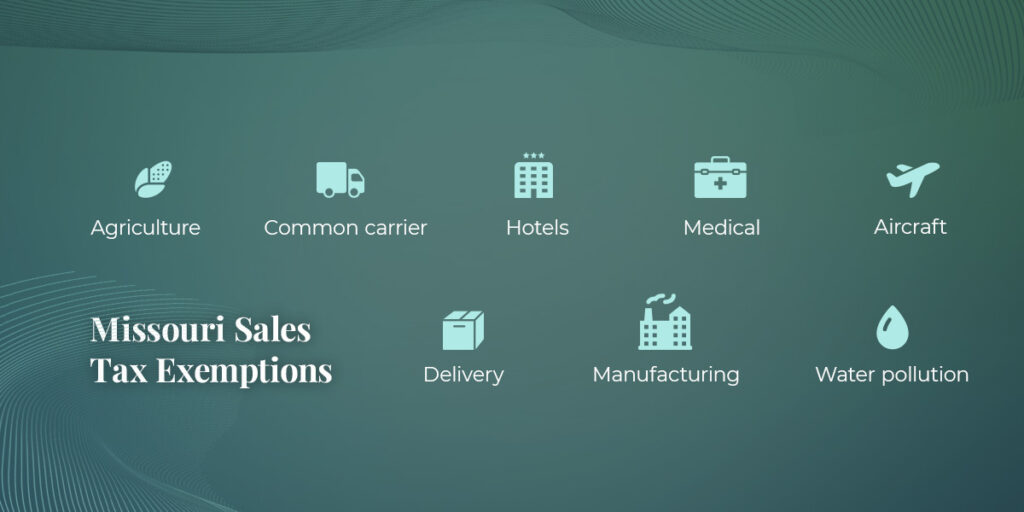
Missouri sales and use tax exemptions and exclusions cover many industries and service areas, such as:
Missouri holds a back-to-school sales tax holiday for residents. This tax break begins on the first Friday in August and extends over a three-day period, which places a Missouri state and local sales tax exemption on certain purchases. As defined by the state statute, many items required for schooling are exempt from state and local sales taxes within this period. These items include:
If your business fails to collect Missouri sales tax, you will likely receive a warning letter with the payment deadlines. If you do not resolve your tax obligations after that, you will likely incur penalties and interest on the taxes you owe or be subject to a sales tax audit.
Common ways that a business can fail to comply with sales tax requirements include:
Your business may be selected for an audit if the Missouri DOR believes your business is underreporting or underpaying sales tax. Your business may also be audited if you fail to collect or remit sales tax. If you are selected for an audit, an auditor or representative from the DOR will contact you by mail or phone. If you receive an audit notice, you will have follow-up discussions regarding the audit period, account records and when the audit will be conducted.
After this point, there are several factors to consider. As a business owner, if you do not have prior experience dealing with audits, you may not know how the process works or when to provide certain documents. In addition, you may not thoroughly understand your risk for exposure when it comes to sales and use tax or whether your assigned state auditor is following proper procedure. If you don’t understand sales tax in Missouri generally, this can become even more complicated.
If you do not feel confident in your ability to navigate the audit successfully and protect your business at the same time, it’s worth hiring a tax professional. A tax attorney who can provide services like IRS account investigation, sales tax representation and audit representation can guide you through the process of the critical decisions you may face in your sales tax audit.
An experienced professional can handle the process for you and help file an appeal with the Administrative Hearing Commission within 60 days of the assessment if you do not agree with the penalties.
Undergoing an audit can feel intimidating, particularly if you have no prior knowledge of audits. This is why it’s so important to contact a tax professional who can explain the steps to you and help alleviate stress throughout the process.
Though audits happen for many different reasons, they generally involve the same sequence of steps. Once you’ve contacted a tax attorney, you will need to provide the Missouri DOR with a signed power of attorney form for them to communicate with your tax professional about the audit and allow your lawyer to be present for the audit. Your assigned auditor will likely conduct the audit at your business location.
The complexity of your records and the size of your business influence how long the audit will take, but you can expect the process to take several days to about a week. Your auditor will examine your federal income tax return to reconcile your sales tax return and other items in your accounting records. Then, the auditor will give you extra time to gather any additional documents they request and schedule follow-up meetings if necessary.
If you plan on opening a business or already have an established business in Missouri, you need to know how to register your business and file your sales taxes with the state to avoid an audit or penalties.
If your business sells tangible personal property or services subject to sales tax, you must register with the Missouri DOR. To do so, you can use the online DOR registration system or fill out the Missouri Tax Registration Application Form 2643 online or on paper.
Before you can register, be sure to have the necessary information on hand:
Depending on your business type, you may also need a separate license, such as if you are a motor fuel supplier.
Once you’ve registered for your sales tax permit, you can file your sales taxes. The most important elements of filing sales tax include calculating how much sales tax your business owes, filing the return and making the payment.
To simplify things, you have several options for filing and paying your business sales tax. You can:
The return dates for sales taxes are different in every state. In Missouri, when you register for your sales tax permit, you’ll also be assigned a filing frequency, which will let you know when you should file your taxes. Generally, this frequency is based on the amount of sales tax your business collects from customers in the state. In Missouri, businesses are required to file sales tax returns monthly, quarterly or annually.
The due dates for filing sales tax returns vary depending on your filing frequency:
If any of your filing due dates fall on a Saturday, Sunday or a holiday, you can still file. As long as you postmark it or file online by the next business day, it will be considered on time. If you still have questions regarding your sales tax return due dates, check out the tax year calendar on the Missouri DOR’s website or contact a tax professional for help.
From knowing which items and services are exempt to filing your taxes correctly, complying with Missouri sales tax regulations can be challenging. At Polston Tax, we deliver many tax services that simplify the entire process. With 25 years of experience, we have the knowledge and resources to meet all your Missouri tax needs.
Our range of tax services includes:

Whether you’re remitting sales tax in Missouri for the first time and need some assistance, or you’re facing an audit and are unsure how to proceed, we’re here to help. To find out how we can meet your tax needs through our services, contact us today.