


Summary: This article provides a concise overview of IRS Revenue Officers and their role in tax collection. Revenue Officers are IRS employees responsible for resolving unpaid tax debts, often through direct interaction with taxpayers. Key functions include assessing financial situations, establishing payment arrangements, and potentially seizing assets. This article emphasizes that Revenue Officers handle more complex cases than automated collection processes. Taxpayers should cooperate but also understand their rights, including the right to representation and exploring resolution options like Offers in Compromise. Engaging with a Revenue Officer requires careful navigation to protect one’s financial interests.
The federal tax agency works with several agents, including Internal Revenue officers. Revenue officers are federal employees tasked to enforce tax laws and collect unpaid taxes. They have certain rights and responsibilities, which, as a taxpayer, you must learn to protect your interests.
This guide covers the distinction between revenue officers and revenue agents, the roles of IRS revenue officers and how to interact with them. Polston Tax represents individuals and businesses that have issues with the IRS and need help communicating with revenue officers. Our tax professionals can leverage our years of experience to help you navigate the complex and intimidating tax challenges.
An IRS revenue officer is a caseworker assigned to collect delinquent taxes. They perform many functions on a case-by-case basis but generally involve contacting individuals and businesses who owe the IRS money. State and local tax departments can also employ revenue officers to assist with tax resolution. Below is a summary of their responsibilities:
Though a government employee, an IRS revenue officer doesn’t carry a firearm and cannot arrest taxpayers. They carry two official forms of identification — an HSPD-12 card and a pocket commission. To qualify for the position of IRS revenue officer, an individual must obtain a bachelor’s degree, preferably with a concentration in economics, statistics or mathematics.
A revenue agent is an auditor who works for the IRS or a state or local government agency to review tax filings and identify discrepancies or errors. Typically, a revenue agent holds a bachelor’s degree in accounting, though they may sometimes hold an associate degree. However, this requirement may be waived if the individual is a certified public accountant (CPA).
A revenue agent may have a specialized background and training. These specialists can hold various titles, such as computer audit specialists (CAS), employment tax specialists (ETS) and financial products and transactions examiners (FPTE).
The job of a revenue agent is to ensure individuals, small businesses and corporations have met their tax liabilities. Some revenue agents exclusively work with the records of suspected criminals, such as money launderers and drug dealers. These agents may need to provide testimony in court. In a basic audit, a revenue agent may contact you via phone or email to discuss your tax return or ask for supporting documents. The revenue agent will determine your tax liability when the audit is complete.
An IRS revenue officer collects taxes, while a revenue agent handles tax audits. A revenue officer tends to cover more challenging tax cases for tax agencies. When the IRS is unable to collect back taxes via phone calls, letters, garnishments or tax levies, it sends a revenue officer to handle the case. A revenue officer has the authority to seize and sell assets that can cover the tax liability and approve or reject a payment plan.
A revenue agent is responsible for assessing a tax liability through an audit, also called an examination. Revenue agents work directly with taxpayers, tax preparers, tax lawyers and taxpayers’ representatives. A revenue agent determines the proper amount owed, while a revenue officer does not play a role in determining what the taxpayer owes. Instead, a revenue officer is focused entirely on efficiently collecting the determined amount of owed taxes.
IRS revenue officers and tax agents are both government agents who work toward getting taxpayers to pay the taxes they owe. Typically, both revenue officers and agents have educational requirements. Many revenue officers and agents are required to obtain a bachelor’s degree. Both work for the IRS, but their positions and responsibilities vary.
Before a revenue officer contacts you, they will usually send information regarding your tax bill in the mail and a deadline by which you should pay, appeal or negotiate a settlement. If you disregard these notices, the IRS will keep contacting you about your back taxes and inform you about the action they plan to take to collect the money you owe. Typically, this starts with a lien and progresses to a wage garnishment or levy. In rare cases, you may receive an email or call from the IRS.
A revenue officer is typically assigned as a last resort after the IRS has already attempted to collect your back taxes via notices, bank levies, tax liens and wage garnishments. Revenue officers are specially trained to collect taxes owed, and with their absolute collections authority, these officers are permitted to act in ways that typical IRS personnel are not.
A revenue officer’s job performance is measured based on how much money they can collect to satisfy your tax liability and how quickly they close your case. Revenue officers are very familiar with the tax code and have the power to garnish wages. As such, when dealing with an officer, you may want to have a tax attorney from Polston Tax on your side.
There are other essential things to know when dealing with revenue offices. Here are some examples:
While the IRS typically won’t call you, a revenue officer can. Tactics used by revenue officers tend to be more extreme than those implemented by other IRS employees, so it’s essential to understand your rights when facing this collection method. An IRS revenue officer’s phone number should be valid, and you can contact IRS customer service if you have any questions.

The IRS will never call you demanding immediate payment via a specific payment method. The IRS does not accept payment via wire transfers, prepaid debit cards or gift cards. If you have received a call you believe could be a scam, it’s vital to review what types of payments the IRS accepts and never give your debit card or credit card information over the phone.
Fortunately, you have the right to representation, and if you opt to be represented by Polston Tax, a revenue officer should contact us instead. When you partner with us, you will have a tax attorney who can handle your case and meet with the revenue officer alongside you. We will be at your side and ensure the officer respects your rights.
When you owe back taxes and neglect to respond to the IRS’s previous collection attempts, a revenue officer may garnish your wages or seize your assets unless you pay what you owe. If you cannot pay your back taxes in full, you may be able to negotiate a payment plan.
A reasonable payment plan with the IRS involves affordable monthly payments, though the IRS may also want some money upfront. The more reasonable the resolution, the more likely the IRS will accept it. To successfully negotiate with the IRS, hire a tax attorney from Polston Tax. With our tax resolution services, we can provide you with the tax help you need.
Revenue offices cannot harass you about your tax liability. If you are being harassed by someone claiming to be an IRS revenue officer, first consider that this may be a scammer. These scammers claim to be from the IRS to exploit vulnerable taxpayers. Constant emails, calls, or excessive physical letters may indicate that this person is not from the IRS. The IRS will not ask that you pay immediately or threaten you with jail time.
In the rare case the harassment is coming from an actual IRS revenue office, follow these steps:
Some actions that may qualify as harassment include:

It is essential to be professional when communicating with IRS revenue officers. Refrain from using offensive language and insults, and be polite. The following tips may be helpful:
If you meet with a revenue officer and then decide that you would prefer to have representation, they must suspend the interview and allow you to hire an authorized representative. You are also allowed to record an in-person interview with a revenue officer.
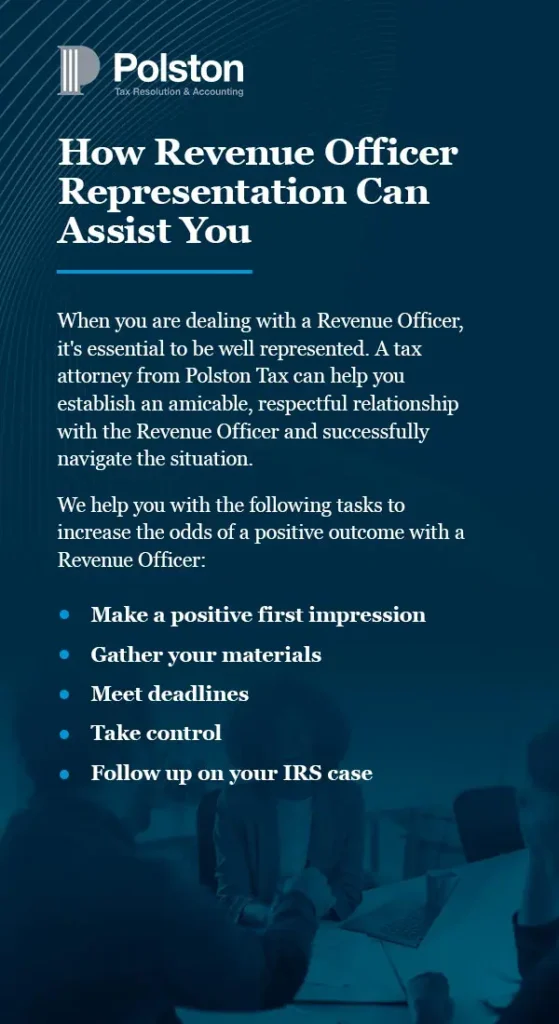
It’s crucial to be well-represented when dealing with revenue officers. A tax attorney from Polston Tax can help you establish an amicable, respectful relationship with the revenue officer and successfully navigate the situation. The following can increase the odds of a positive outcome:
Hiring representation to deal with a revenue officer and reach the ideal tax resolution is essential for many taxpayers. A tax attorney can help you resolve disputes and get a tax resolution with the IRS.
Getting a revenue officer assigned to your case means the IRS is ready to commence aggressive collection actions. It’s best to partner with a tax attorney with experience handling complex issues to assist. At Polston Tax, we represent individuals and businesses engaging with revenue officers to develop practical solutions.
Since 2001, we have provided comprehensive and efficient services to our clients. Our team understands the inner workings of the IRS and can guide you throughout the process. Contact us now to schedule a free consultation. We are ready to help!