


Falling behind on federal taxes can bring a mix of dread and confusion, especially once notices from the IRS start arriving. Fortunately, the IRS offers resolution paths for taxpayers facing financial distress or limited ability to pay, including Currently Not Collectible (CNC) status and an Offer in Compromise (OIC).
Learn how each program functions and how to recognize the right fit for your circumstances.
The IRS grants CNC status when a taxpayer genuinely cannot afford to pay anything toward their tax balance without sacrificing basic living expenses. Once approved, CNC status generally pauses most active collection actions, such as wage garnishments and bank levies, while the status remains in place.
It’s worth noting that the pause only applies to collection activity, not to the balance itself, which doesn’t disappear. Even after moving to pause the collection efforts, interest and penalties keep accruing, a federal tax lien may still get filed, and future refunds can be applied to what’s owed.
Qualifying for this status generally requires showing that you cannot make payments after covering basic living expenses, typically documented through Form 433-F. The IRS periodically reviews finances after granting this status, so the decision to file for CNC status comes down to weighing a temporary pause against the risk that collections resume.
Through an OIC, qualifying taxpayers can settle their federal tax balance for less than what they owe. Rather than approving offers on a case-by-case basis out of sympathy, the IRS calculates a taxpayer’s Reasonable Collection Potential. This formula weighs income, monthly living expenses, equity in assets and future earning ability.
The IRS may accept an offer when the taxpayer’s income and assets fall short of the full balance, the assessed amount is genuinely in question or paying in full would cause undue hardship despite being technically possible.
Getting an offer under review typically requires Form 656, the appropriate financial disclosure form and application fee, and any required initial payment, with certain costs waived for qualifying low-income taxpayers. This route settles only federal taxes owed and requires five years of tax compliance afterward to avoid reinstating the balance.
When comparing IRS hardship options, here are some differences to bear in mind.
With CNC, your unpaid taxes are not reduced, and interest and penalties can continue to increase the total amount owed. Eventually, the amount will become collectible again.
Conversely, with an accepted OIC, once the agreed amount is paid in full and the taxpayer meets the required compliance terms, the IRS settles the account and does not pursue the remaining balance solely because finances later improve.
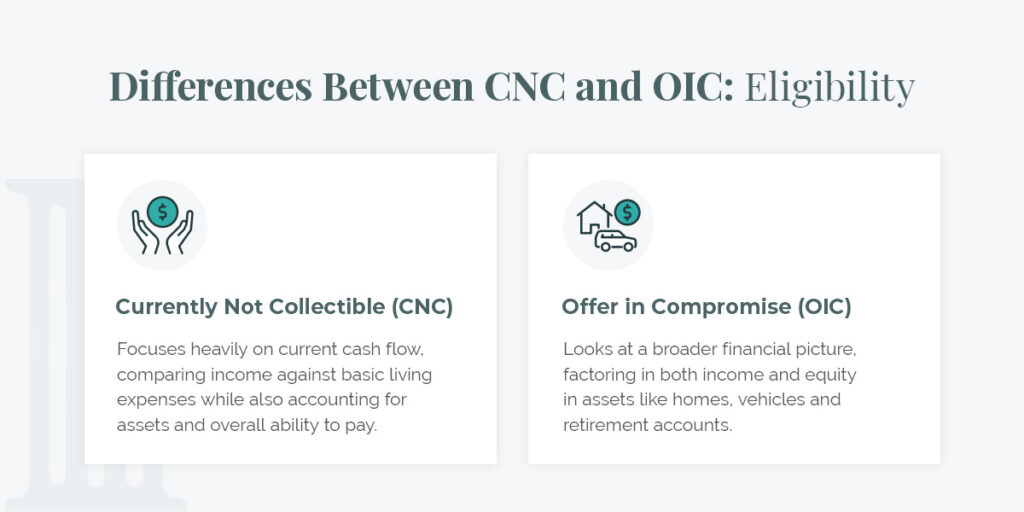
CNC eligibility focuses heavily on current cash flow, comparing income against basic living expenses while also accounting for assets and overall ability to pay. In contrast, OIC eligibility looks at a broader financial picture, factoring in both income and equity in assets like homes, vehicles and retirement accounts.
An OIC takes considerably longer to review than a CNC request, with a process that can stretch up to two years from submission to decision. That review process requires a complete application, all supported by thorough documentation. A single missing form can cause the IRS to return the offer as not processable with no appeal rights since it isn’t a rejection. A miscalculated figure can lead to rejection, which comes with 30-day appeal rights. Having a knowledgeable reviewer check the application before submission is strongly recommended.
The following financial signals can help clarify your likely path:
In a situation where neither option fits, and you can make some monthly payments but not the full amount, setting up an Installment Agreement may be worth exploring instead.
Many legally assessed federal tax balances are subject to a collection window, generally 10 years from the assessment date, known as the Collection Statute Expiration Date (CSED). After this time elapses, the IRS can no longer pursue collection.
Long-standing hardship under CNC status may allow the collection clock to keep running, since CNC generally does not suspend the CSED. However, other actions or circumstances of the case can affect the collection window. An OIC changes the math because the IRS generally suspends the collection period while the offer is pending, and the suspension can extend further if the offer is rejected or appealed.
As a result, a balance nearing expiration may make CNC status worth evaluating, whereas a newer balance calling for a permanent fix may make an OIC worth considering.
When deciding between CNC and OIC, Polston Tax brings direct, hands-on experience to help you make the choice. Here’s what sets us apart as a trusted tax resolution resource:
Choosing between the CNC status and an OIC starts with a clear look at your finances, not a guess. At Polston Tax, we start every case with a full financial analysis to determine which resolution path best fits your circumstances before any paperwork moves forward.
Schedule a free consultation with our team before IRS or state tax collection activity escalates and get a clear, personalized recommendation for resolving your tax balance with the IRS or a state taxing entity.