
Owing back taxes to the Internal Revenue Service (IRS) can feel like living under a countdown you can’t see. Maybe they’ve piled up alongside business expenses, or complex filing requirements and IRS letters have left you feeling overwhelmed. Many taxpayers don’t realize that the IRS operates under a hard legal deadline of its own. After assessing a tax, the government generally has 10 years to collect it under the IRS statute of limitations.
Certain actions, such as requesting a payment plan or living outside the U.S., can pause or extend that window. Knowing where the clock stands can help you determine the optimal tax resolution strategy.
The Collection Statute Expiration Date (CSED) is when the IRS loses its authority to collect a tax balance, along with any associated penalties and interest. This date generally falls 10 years after the IRS’s tax assessment date — not on the date you filed your return. The assessment date can occur weeks or months later, and one account can carry several CSEDs. Each of the following gets its own assessment date:
The most strategic tax resolution typically depends on your balance’s assessment date.
Several actions or events can suspend or extend the 10-year deadline. Knowing these events can help you determine how long the IRS has to collect a given balance. Examples include:
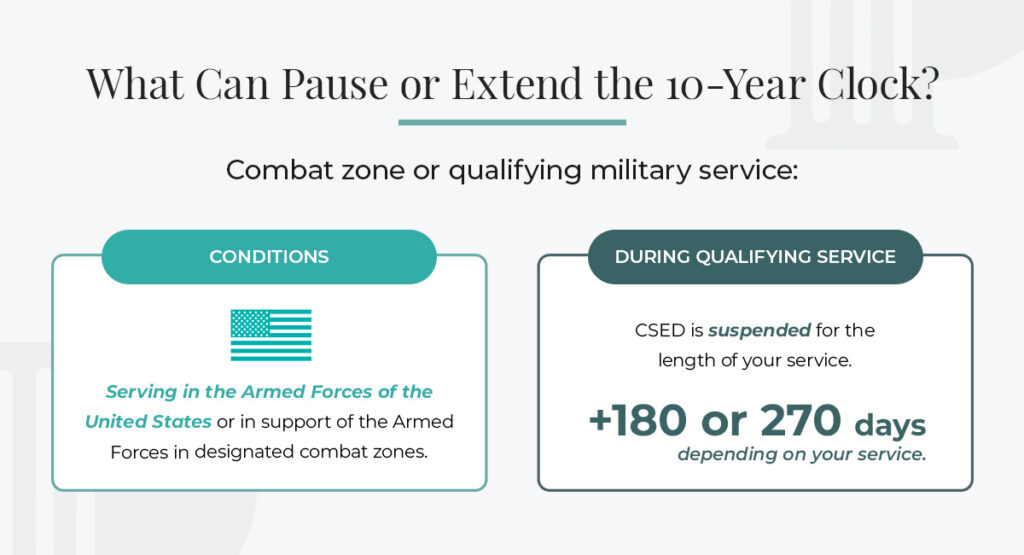
Understanding the suspensions and extensions can help you avoid expiration date assumptions. You may reconsider activities if they delay the CSED. The IRS cannot extend CSED on its own under the Taxpayer Bill of Rights, except when you agree to an extension as part of a written installment agreement or when the government secures a court judgment.
The CSED typically influences your optimal resolution strategy. Closer dates give the IRS diminishing leverage, which tends to favor options built around waiting it out. More years on the clock give the IRS stronger enforcement authority, which can shape how aggressively it pursues levies and how much room exists to negotiate a lower settlement. Depending on your situation, these strategies can help:
While IA requests suspend CSED during review, active IAs don’t. The 10-year clock runs while you make monthly payments, which can work in your favor, since the IA makes payments more manageable. Closer expiration dates may motivate the IRS to push for unrealistic terms that hurt your budget, making IAs ideal for later CSEDs. However, you’re not required to accept terms that you can’t sustain.
An OIC can be another suitable resolution strategy, as it lets you pay taxes for less than the amount you owe. Shorter CSED windows offer less future collection potential for the IRS, which can make your request more favorable. Larger collection windows lead to larger losses.
However, keep the review period in mind. If the review period, therefore the suspension, runs for six months, and the CSED is in the seventh month, the application might not be worth more than the waiting game. Also, consider that OIC only applies to IRS balances, not state tax obligations.
A currently not collectible (CNC) status temporarily suspends IRS collections. The IRS gives this status to taxpayers who can’t pay without sacrificing their basic living expenses. Requests don’t suspend the CSED, making the status a strategic solution for tax balances with limited time left. However, a CNC status is not permanent. The IRS reviews the status periodically and can lift it if your finances improve.
Polston Tax has worked exclusively in tax resolution and accounting since 2001. Every case gets a team approach, consisting of tax attorneys, case managers, accountants and tax preparers. Your case will receive the attention and experience it deserves.
Our process involves analyzing your finances fully, reviewing account transcripts and verifying your actual CSED before recommending any strategy. From there, we handle all IRS or state taxing entity communications, so you’re not navigating notices and deadlines alone.
As a full-service tax resolution and accounting firm, Polston Tax helps taxpayers navigate unpaid taxes, audits and levies or liens. We also handle tax preparation and business accounting, so you can stay focused on your operations.
If unpaid taxes are close to the expiration date, we can help you apply for a CNC status to pause enforcement. We can also help you qualify for a reduced settlement through an OIC. If a manageable monthly plan makes more sense, our installment agreement services can help keep the IRS from pursuing your assets.
Get a free consultation today to find the optimal resolution path for your timeline.